Buy Now

Buy Now

Buy Now

Need parts?

Buy Now

UVC Safety and Compliance for OEMs

Technical Brief
By Gary Kardys, CMO

Using UVC as a “miracle sterilizer” without accounting for efficacy, safety standards, exposure limits, regulatory constraints, and proper engineering controls is risky. You’ll want to ensure any proposed UVC‑based product — whether for air disinfection, surface sterilization, water purification, medical device sanitization, or OEM integration — is carefully specified, tested, and labeled.

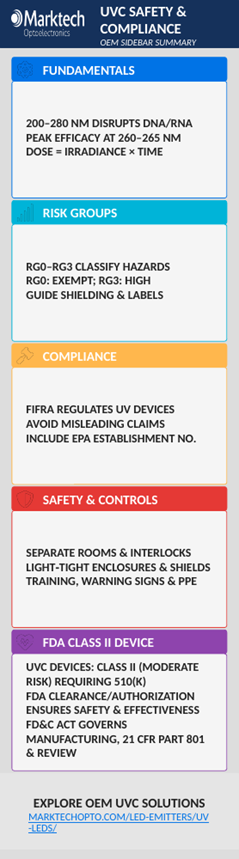
  • UVC Efficacy Fundamentals: UVC radiation spans 200–280 nm, with peak germicidal efficacy at 260–265 nm. Effective disinfection depends on the dose, defined as irradiance multiplied by exposure time.
  • Risk Groups: IEC 62471 classifies optical hazards into Risk Groups 0 through 3 (RG0–RG3). RG0 sources are exempt, while RG3 sources are classified as high hazard; these classifications guide shielding, interlock, and labeling requirements.
  • Compliance: In the United States, UVC devices are regulated under the Federal Insecticide, Fungicide, and Rodenticide Act (FIFRA). Manufacturers must register their establishments, include an EPA establishment number on devices, and avoid unsubstantiated claims about pathogen reduction.
  • Safety & Controls: Engineering controls include enclosing UVC sources in separate rooms or cabinets, adding interlocks on doors, and using light tight enclosures and reflective shields. Administrative controls cover training, hazard signage, and personal protective equipment (PPE) such as UV blocking eyewear and gloves.
  • FDA Class II Device: Most UVC disinfection devices are considered Class II (moderate risk) medical devices by the FDA. They require Premarket Notification [510(k)] to demonstrate safety and efficacy compared to existing devices. FDA clearances or authorizations (including De Novo classifications) ensure suitability for clinical use. These devices are regulated under the Federal Food, Drug, and Cosmetic Act (FD&C Act), including labeling provisions (21 CFR Part 801) and premarket review.

New UVC Photobiomodulation Medical devices in contact with the body or under development for specific new phototherapy treatments would require additional FDA approvals. These UVC medical devices will typically require a series of clinical trial to prove efficacy and safety (minimal harmful side effects).  When a predicate device exists, manufacturers can obtain clearance via the 510(k) premarket notification process and are not required to run new clinical trials. the FDA accepts non‑clinical performance testing to show the device is substantially equivalent to an existing product.

References
•             LBNL: Light emitting diodes (LEDs) – optical safety guidance
•             EPA: Federal Insecticide, Fungicide, and Rodenticide Act (FIFRA)
•             FDA press announcement: September 8 2023 roundup

Explore all of our UV LEDs here:
https://marktechopto.com/led-emitters/uv-leds/ 

Explore all of our UV Deetectors here:
https://marktechopto.com/detectors/uv-detectors/

UVC Safety and Compliance for OEMs inforgraphic

Related Articles

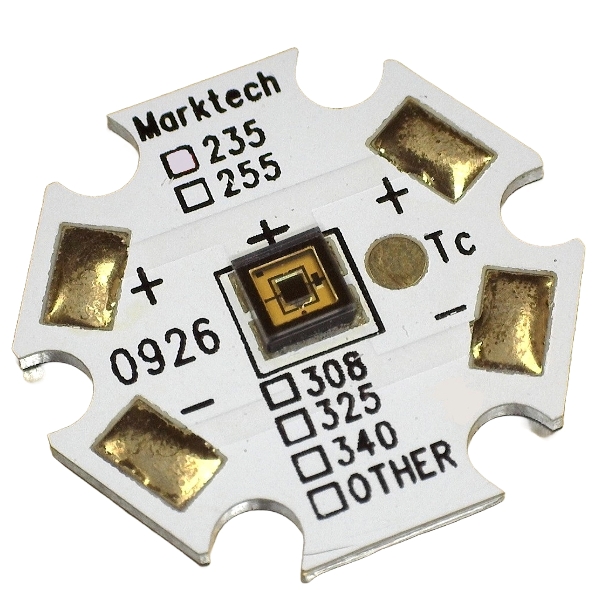
Image opf Deep UVC 235nm LED mounted on a metal-cored starboard for rapid prototype and design evaluation.
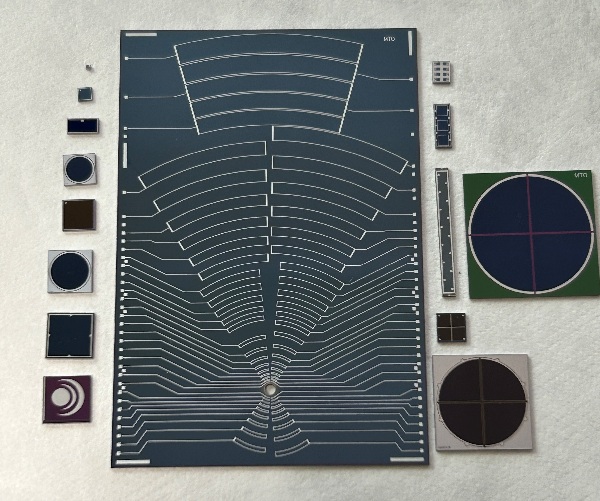
Small image of variety of Marktech West silicon photodiodes
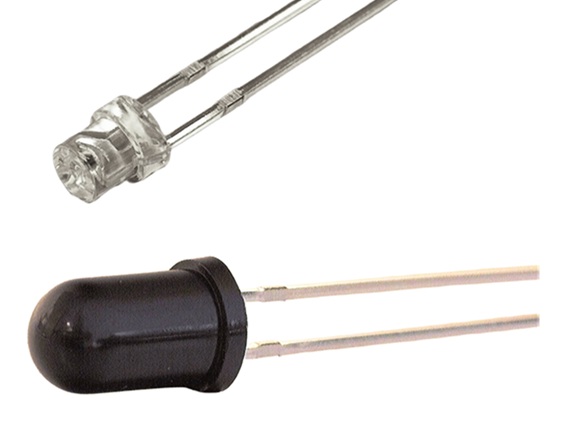
Images of New SiPDs with minimal-to-no visible-light sensitivity (MTD3910GC-F3 & MTD3910G-F3) and a blue-green-optimized device with 525 nm peak responsivity (MTD5052D3)